

The short version: bid only when you can win
- Most teams lose more bids from saying yes too often than from writing badly, because chasing volume spreads resources thin and produces average proposals across the board.
- A scored bid/no-bid framework built on six criteria replaces gut instinct with a repeatable decision that the whole team can apply.
- The hardest opportunities to qualify are the ones that sit on the fence, where relationship intelligence and competitive awareness tip the decision.
- The window between deciding to bid and starting to write is where the best teams gain their edge: clarification questions, evaluation mapping, and team mobilisation all happen here.
- Running a compliance check against the RFP before the main writing effort begins tells you where the gaps are while there is still time to close them.
Every salesperson, account manager, and BD lead has felt it. The RFP lands. The revenue number looks right. Someone says “we should go for this.” And before anyone has properly read the document, the team is committed.
Two weeks later the proposal goes out, written in evenings and between meetings by people who were already stretched. It reads like what it is: a rushed document produced by a team that was doing three other bids at the same time. The loss, when it comes, shouldn’t surprise anyone. But it always does.
The bid/no-bid decision is the single highest-impact choice a sales team makes, and most teams struggle to make it well. Not because they lack intelligence or experience, but because the decision is rarely made on merit alone. Internal politics, client pressure, a senior partner who insists “we need to be seen to bid on this,” the fear of leaving revenue on the table. These forces push teams towards yes before anyone has properly assessed whether the opportunity is winnable. Without a structured way to make the call, optimism fills the gap. The result is a win rate that sits stubbornly below where it should be.
The real cost of bidding on the wrong opportunities
The cost of a lost bid is not zero. It is the fully loaded cost of every hour your team spent on it, plus the opportunity cost of the bids they could have been working on instead. The real cost is larger than most teams realise.
A typical mid-market proposal consumes 40 to 80 hours of effort across the team. For a company running 15 to 25 bids a year, that is somewhere between 600 and 2,000 hours of total bid effort. If half of those bids were never realistic prospects, you have burned 300 to 1,000 hours on opportunities that were lost before the writing started.
That is not just wasted time. It is actively damaging. Every hour spent on a weak opportunity is an hour not spent on a strong one. The proposals you should have won get the same thin, rushed treatment as the ones you were never going to win. Quality drops across the board, and the win rate follows it down.
The maths is simple. A team that responds to 20 RFPs and wins 4 has a 20% win rate. The same team responding to 12 well qualified RFPs and winning 5 has a 42% win rate, with fewer hours spent and better morale across the team. Selectivity is a strategy, not a luxury.
A scored bid/no-bid decision framework
Gut instinct is fast, but it is unreliable. The opportunity that feels exciting on Monday looks different by Wednesday when you realise the buyer has an incumbent they have worked with for six years. A scored framework forces the conversation that gut instinct skips.
Score each of the following six criteria on a scale of 1 to 10, where 1 means no fit and 10 means ideal conditions.
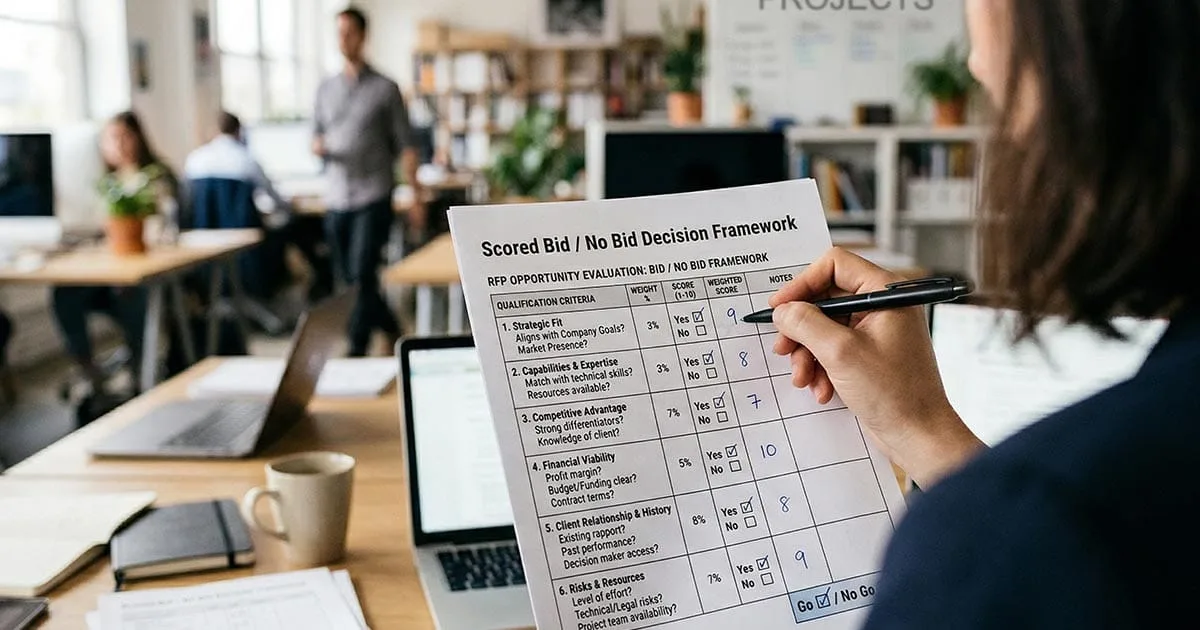
Strategic fit
Does this opportunity align with what your company actually does well? A construction firm that excels at infrastructure projects should think carefully before bidding on a residential development tender just because the value is attractive. Score 8 to 10 if the work sits in your sweet spot. Score 1 to 3 if you would be stretching into unfamiliar territory.
Relationship strength
Do you have an existing relationship with the buyer, or are you responding cold? This does not mean you need to be the incumbent, but having spoken to someone on the buying side, understanding their priorities, and knowing what matters beyond the written brief is a genuine advantage. Score 8 to 10 if you have a strong, warm relationship. Score 1 to 3 if you have never spoken to anyone at the organisation.
Resource availability
Can you assemble the right team and give them enough time to produce a quality submission? If your best subject matter expert is on holiday, your proposal lead is already running two other bids, and the deadline is ten working days away, a score of 2 or 3 is generous.
Sector or buyer win history
Have you won similar work before, with this buyer or in this sector? A track record of relevant wins gives you case studies, references, and confidence in pricing. If this is your first bid in a new sector, that is not disqualifying, but it does push the score towards the lower end and means the rest of the criteria need to compensate.
Competitive landscape
Who else is likely to bid, and where do you sit relative to them? If the RFP has been written around a competitor’s solution, or if the incumbent has a relationship advantage you cannot match, that is a 1 or 2 regardless of how well you write. If you genuinely believe you are the strongest or equal strongest candidate, that is a 9 or 10.
Time available
Not calendar time, usable time. A three week deadline where the first week is Christmas and your technical lead is in client workshops for the second is really a five day deadline. Score based on the actual time your team has to produce a quality response, not the time between now and the submission date. Why experienced bid managers never submit on deadline day.
Setting a threshold
Add the six scores. The maximum is 60. The minimum is 6.
45-60: Bid. This is a well qualified opportunity. Commit the team and give it proper resources.
30-44: Discuss. The opportunity has potential but also has weaknesses. This is where the grey zone framework below becomes useful.
Below 30: Walk away. Multiple criteria scored poorly, and the total confirms what you probably already suspected. Decline politely and invest the time where it will produce a better return.
The threshold is not a rigid rule. It is a conversation starter. The point is to have the conversation before committing, not after the team has already started writing.
How to qualify an RFP when the score sits on the fence
The hardest opportunities are not the clear wins or the obvious declines. They are the ones scoring 30 to 44, where the decision could go either way. Three questions help break the tie.
What do you know that is not in the RFP? Relationship intelligence matters here. If you have spoken to the buyer and you know their real priorities, their frustration with the incumbent, or the internal politics shaping the procurement, that context changes the calculation. A score of 35 with strong inside knowledge is different from a score of 35 going in blind.
What happens if a competitor wins this? Some opportunities carry strategic weight beyond the revenue. If losing this bid gives a competitor a foothold in your strongest account, or if winning it opens a door to a larger framework, that changes the maths. Be honest about whether this is genuine strategic importance or just competitive anxiety dressed up as strategy.
Can you materially improve your position before committing? Sometimes the difference between a 34 and a 45 is a single conversation. If you can get clarity on the buyer’s priorities, secure a named expert for the team, or confirm that a competitor is not bidding, the score changes. If there is nothing you can do to improve your position, the current score is the one you are working with.
Boosting your chances before the writing starts
Deciding to bid is not the same as starting to write. The best teams treat the gap between qualification and drafting as its own distinct phase, and they use it deliberately.
Submit clarification questions early. Every formal procurement process includes a window for supplier questions. Most teams either skip it entirely or submit generic questions that reveal nothing. The teams that win use this window to clarify ambiguities in the evaluation criteria, understand how responses will be scored, and surface assumptions that could trip them up later. One well placed question can reshape your entire approach.
Map the evaluation criteria before you write a word. Open the RFP and find the scoring methodology. If the buyer allocates 40% of the score to technical approach and 10% to price, your proposal should reflect that weighting. If quality scores are assessed using MEAT criteria (most economically advantageous tender), understand what each criterion means in practice. Do this mapping before a single section is drafted, not after.
Pro tipCreate a simple table with three columns: evaluation criterion, weighting, and the section of your proposal that addresses it. This becomes your compliance map. Any row with an empty third column is a gap you need to fill before you start writing.
Assemble the right team while you still can. Once the writing starts, you are locked into whoever is available. The pre-bid window is the time to identify the right subject matter experts, check their availability, and brief them on what the buyer is looking for. A proposal written by the right people from day one is fundamentally different from one where the right people were drafted in at the last minute to review something they had no hand in creating.
Run an early fit assessment. Before the team invests significant hours in drafting, check your initial response against the RFP requirements. This does not need to be a polished document. Even a rough outline mapped against the buyer’s criteria will reveal whether you have a credible answer for every requirement or whether there are gaps that need addressing before the main effort begins.
The discipline that improves your win rate
Proposal win rate improvement does not come from writing better sentences. It comes from making better decisions about where to invest your effort. A go/no-go framework is not about saying no more often for the sake of it. It is about recognising that your team’s capacity is finite and that every bid you commit to is a bet.
The teams that win consistently are not the ones that bid on everything. They are the ones that qualify ruthlessly, prepare thoroughly, and give their best people enough time to do their best work. The framework above takes fifteen minutes to complete for any given opportunity. The return on those fifteen minutes, measured in hours not wasted and bids not lost, is difficult to overstate.
Start with the next RFP that lands on your desk. Score it. Have the conversation. And if the number says walk away, walk away. The right opportunities will still be there, and you will be ready to give them the attention they deserve.
Once you have decided to bid, make sure the proposal earns the decision. ReqFit checks your draft response against the RFP, requirement by requirement, so you know exactly where the gaps are while there is still time to close them. Try ReqFit free, no credit card required.
Get your free reviewFrequently asked questions
Score the opportunity against a set of qualification criteria before committing resources. The six that matter most are strategic fit, relationship strength, resource availability, sector win history, competitive landscape, and time to produce a quality submission. If more than two criteria score low, the opportunity is probably not worth pursuing.
A bid/no-bid framework is a structured scoring method for deciding whether to respond to an RFP. Each criterion is scored on a simple scale, and the total determines whether the opportunity clears a minimum threshold. It replaces gut instinct with a repeatable process that the whole team can apply consistently.
There is no universal number. The right volume depends on your team's capacity to produce quality submissions. Most teams would improve their win rate by responding to fewer RFPs and investing more time in each one. If your proposals are consistently average, you are probably bidding on too many opportunities.
Yes. The period between deciding to bid and starting to write is valuable. Submit clarification questions early, map the evaluation criteria before drafting, and assemble the right team while there is still time. Then run a compliance check against the RFP before the main writing effort begins to identify gaps early.


