How ReqFit works
Upload your RFP and proposal. In minutes ReqFit checks every requirement, scores your coverage and lists what to fix before you submit. First review free.
Three steps. One report.
One click. Three steps. What follows is what happens between them.
Upload
Drop in the RFP and your proposal, or a questionnaire and your responses. Word, PowerPoint, PDF, or a mix of all three. No setup. No prompt engineering. It is drag and drop simple.
AI analyses
The 5 stage AI pipeline reads your documents, extracts the requirements, maps your responses, and scores how well each requirement is covered.
Get your report
View online or download a structured PDF or Word report you can act on, share with your team, or attach to an internal sign off.
Inside the AI pipeline
ReqFit runs on Google Cloud Vertex AI. It is not a chatbot you have to coach. It is a multi-stage pipeline purpose-built for one job: comparing a proposal against the requirements in an RFP and producing a structured review you can use. Here is what happens between upload and report.
Document ingestion
All documents are parsed into structured text. Section structure, tables, headings, and embedded text from PDFs are preserved. Word, PowerPoint and PDF formats are supported.
Requirement extraction
The AI reads the RFP or questionnaire and identifies the requirements, evaluation criteria, and mandatory questions it finds. Each one is given an ID and tagged with its source location and priority.
Coverage analysis
Your proposal is cross-referenced against the extracted requirements. The AI maps responses to specific requirements, identifying where coverage is direct, where it is partial, and where it is missing.
Scoring and gap identification
Each requirement receives a coverage rating: Strong, Adequate, Weak, or Missing. Gaps are tagged by priority and the pipeline produces an overall coverage score plus a section by section breakdown.
Report generation
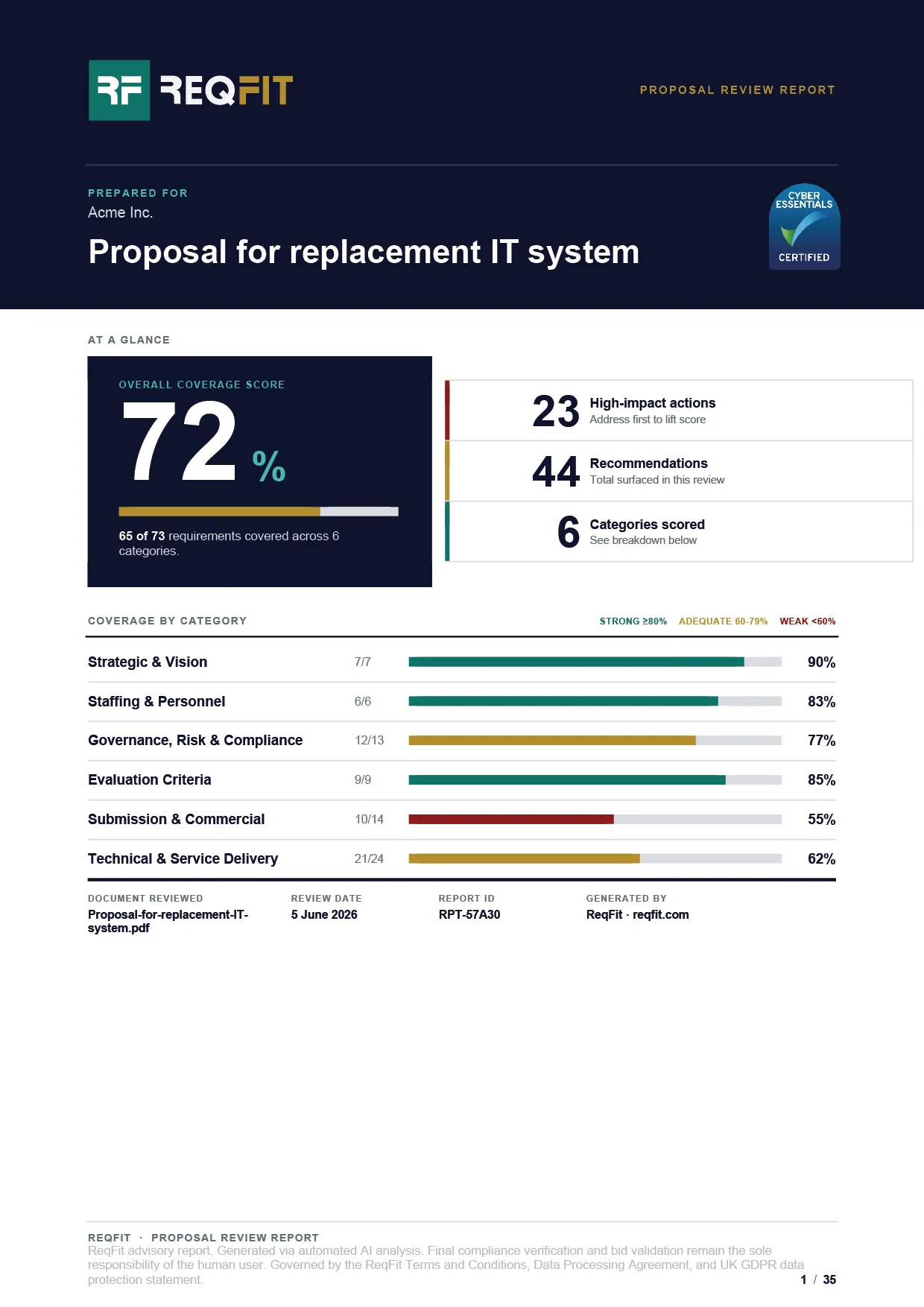
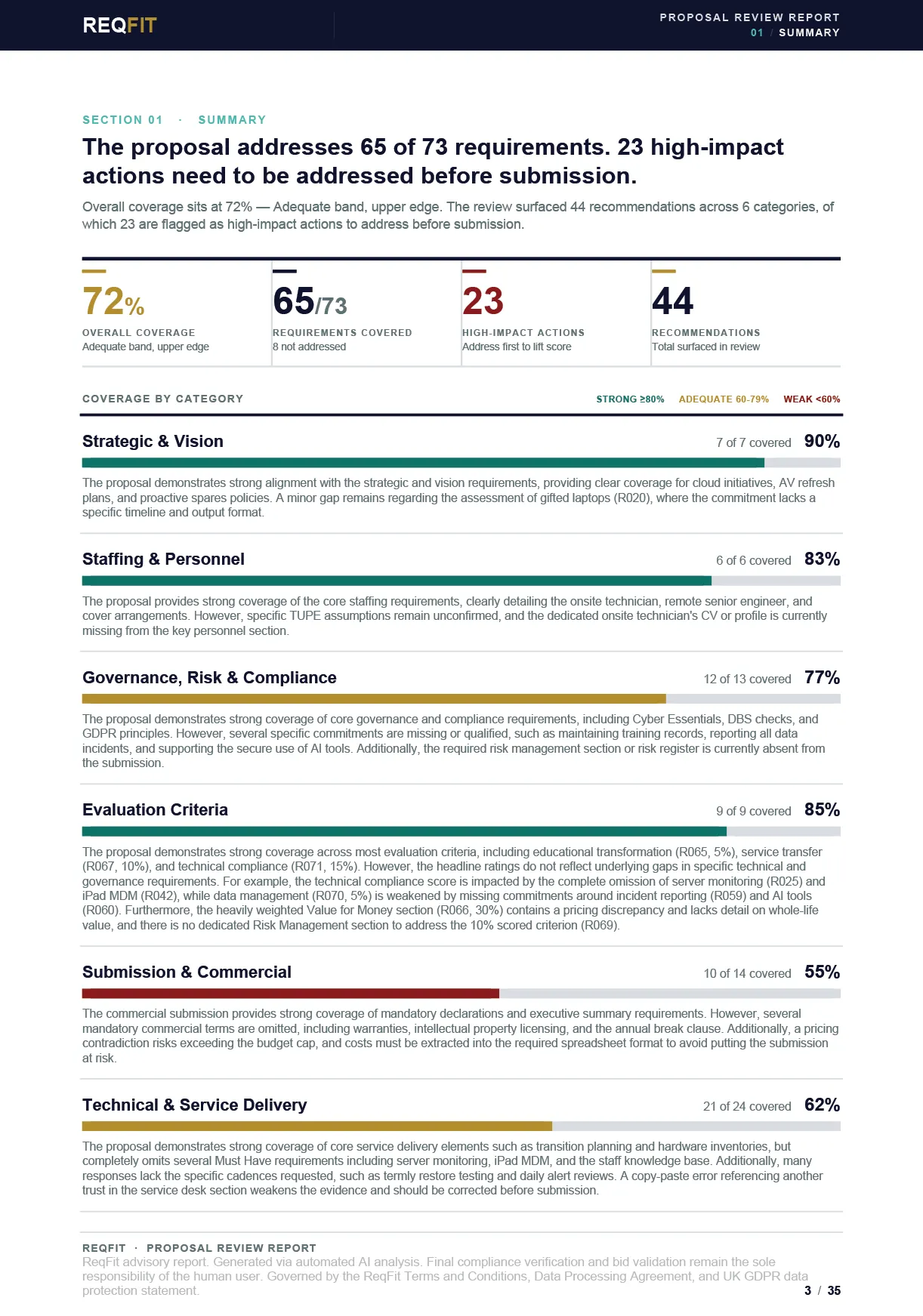
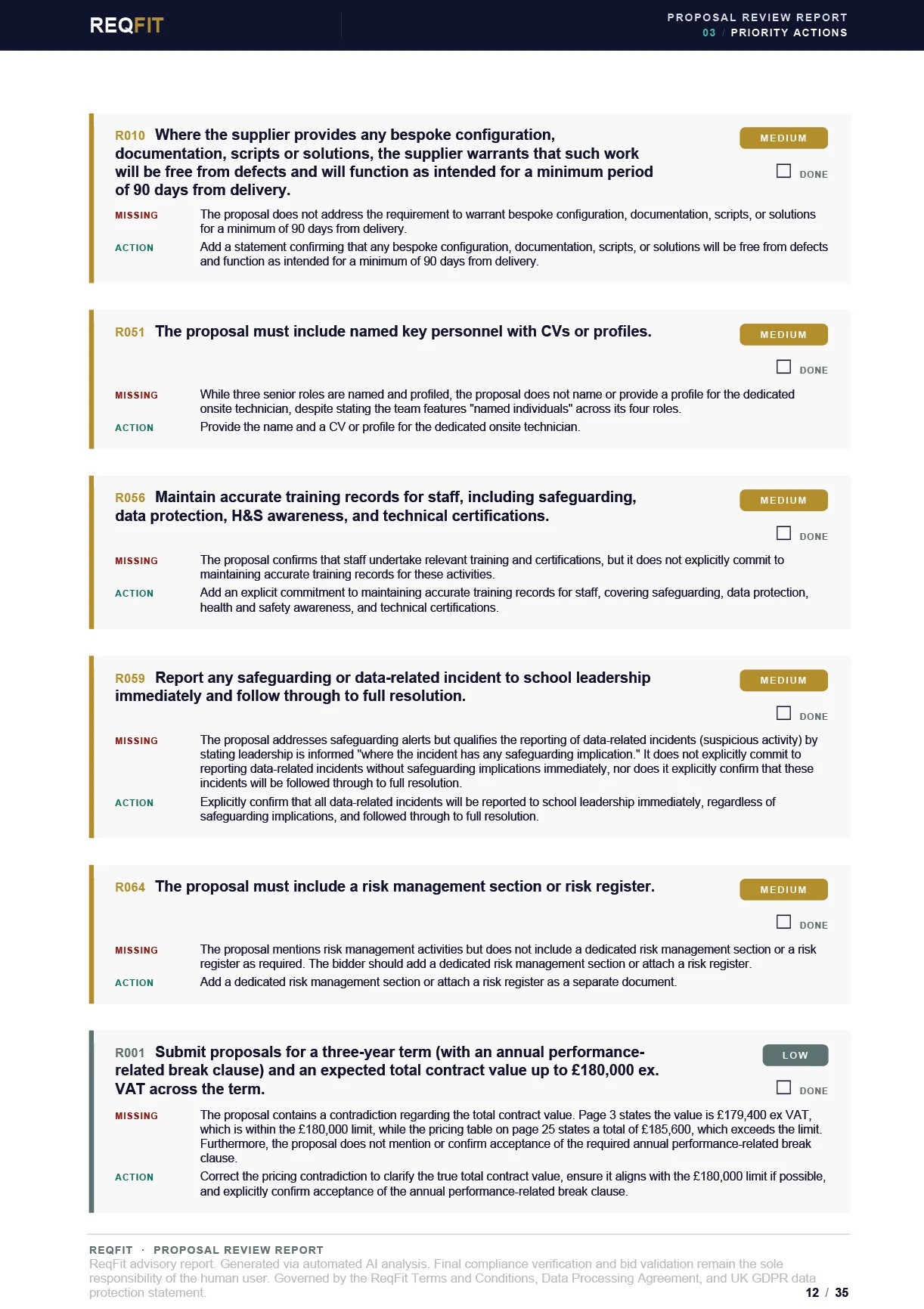
The full analysis is rendered into a structured report: a summary with the headline coverage score, submission readiness, priority actions, compliance confirmations, and a per-category breakdown.
The whole pipeline runs end to end without your input.
Also works for due diligence questionnaires
A due diligence questionnaire is a structured set of questions, which is the same shape of problem the pipeline is built for. Upload the questionnaire and your completed responses, plus any attachments your answers refer to. ReqFit treats each question the way it treats a requirement, working through them one by one and showing you which your responses cover and which still need attention before you return the document. It checks how well your responses cover what is asked. It does not judge whether your answers will satisfy the assessor.
The report
Every ReqFit report follows the same structure, so you and your team always know where to look.
- 01 Cover and about this report
- 02 At a glance
- 03 Submission readiness
- 04 Priority actions
- 05 Compliance confirmations
- 06 Detailed breakdown
- 07 Next steps
The report is viewable online and can be downloaded in both Word (.docx) and PDF format. Edit it, share it, or attach it to an internal sign off. It is yours.
Not a chatbot. Not a writing tool. A purpose built AI reviewer.
ReqFit is not a general purpose AI assistant. It does not write your proposal, suggest replacement copy, or answer questions about your bid. It does one thing. It tells you, with evidence, where your proposal does and does not match the brief. The final check on accuracy and completeness before you submit stays with you.
Structured output
Every report follows the same format: the same sections, the same scoring scale, the same evidence trail. You can read the second one as fast as the first because you already know where to look.
Domain reasoning
The pipeline understands what an RFP or questionnaire is. It knows the difference between an evaluation criterion and a context paragraph, between a hard requirement and a nice to have, between a question that needs a specific answer and one that needs a narrative.
Grounded in your documents
ReqFit works from the source text of your RFP and proposal, not from generic assumptions. Each review measures your draft against the same extracted requirements baseline, so a re-run is judged against a fixed standard.
Built on Google Cloud Vertex AI
ReqFit is built on Google Cloud Platform's Vertex AI. We use a multi-model approach. Different models are routed to different stages of the pipeline based on the task. Document parsing, requirement extraction, coverage reasoning, and report generation each have a dedicated model configuration tuned for the job. This matters for three reasons.
Engineered for the task
A general purpose AI tool cannot reliably produce a structured proposal review. It can give you opinions, suggest rewording, and answer questions about your bid. It will not work through the requirements in a forty page RFP, map them to your responses, and score coverage in a structured way. The ReqFit pipeline is engineered for that specific task.
There when a deadline is
Built on managed, production-grade Google Cloud infrastructure, so the service behaves predictably and is there when a deadline is. Each review runs against the same extracted requirements baseline, so a re-run measures your new draft against a fixed standard. No prompt engineering required from you.
Processed inside Google Cloud
Vertex AI processes your documents inside Google Cloud. Source documents are discarded once your report is generated; the extracted requirements list is retained against your account and cleared when you delete your account, and reports stay in your dashboard for 90 days. We do not log document content, and we never train our AI on your documents. We are Cyber Essentials certified. Full detail on our security page.
Your data, your control
Source documents are discarded once your report is generated. The extracted requirements list is retained against your account so re-runs measure against the same baseline, and is deleted when you delete your account. Reports stay in your dashboard for 90 days. We do not log document content, and we never train our AI on your documents.
Full detail on data handling, the Vertex AI processing region, AI regulation alignment, and your rights is in How we use AI.
Source documents discarded after processing. Requirements list retained until account deletion; reports retained 90 days. See our security page for the full data lifecycle.
Document processing happens within Google Cloud Vertex AI. No other third party touches your document content.
All uploads and processing use TLS 1.3, including hybrid post-quantum key agreement.
ReqFit staff do not access customer documents at any time. The pipeline runs without manual intervention.
Your documents are never used to train, fine-tune, or improve any AI model.
Our standard Data Processing Agreement is live; a bilateral signed copy is available on request to security@reqfit.com.
Get your one free report
No credit card. No commitment. One free report on every account.
Get your free review